Translate

Saturday, October 15, 2005

THE CRYPT OF FUTILITY


America will soon have to pack away its little treasures, the forget-me-nots and relics of unwholesome war, and lay them in the vast crypt of futility. But before the massive door swings on its creaking hinges and slams tight, we should consider the parable of Kong.

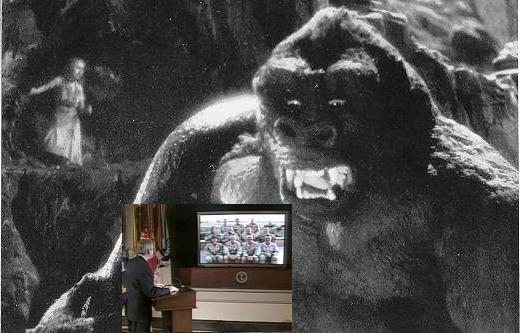
Kong grew addicted to television, and he was expendable. And General Electric Television (NBC),-- what's not to believe? They finally did the right thing, and told him, showed him really, that the President's "spontaneous" interview with our soldiers in Iraq was a faked-up event;--and then happened to mention that the President's whole four-and-a-half years of "public venue" amounted to nothing but a stage-managed facade.

Let no one tell you that beauty killed the beast. No. It was the charade that killed him.

Saturday, October 01, 2005

DIARY OF A RAG AND BONE MAN

(THE CONTINUING SAGA OF A HOMELESS MAN AND HIS DOG)

By Jack Rafter

QUIET NIGHTS

It’s been a hot summer in old Sherwood Forest, but the wind and the rain are coming, spillover from the hurricane, so I guess we’re in for it. Hope no logs fall on our heads. Vincent doesn’t mind rain so much, but he tends to take thunder and lightning kind of personal. Well, I told him we’re still better off than a lot of those refugees pouring out of Orleans. At least I’ve already been through losing my home, although it wasn’t exactly a natural disaster that took it. No, it was just a guy in a three-piece suit. But we do have a nice tent, after all.

Now, New Orleans is flooded again, from the latest hurricane. I went over to Johnny Blair’s cafĂ© the other night and watched the evacuation out of Houston. It looked like a richer grade of people coming out of there, than the ones that got left in New Orleans. Now, the vultures are swarming to the sunny South—-the speculators, the developers, buying up cheap flood land, carving it up. Halliburton is there, too, just like they are in Iraq. The president has suspended a law that would have allowed laborers to be paid $10.40 an hour. Now, contractors are free to hire workers at poverty wages. Business as usual.

* * * *

Sure looks like the world is going to hell. I wonder how many times, in how many places someone has repeated that line—“the world is going to hell”? I wouldn’t know, but I bet it’s a lot. And I suppose people have said it in every age, and every language, as far back as you could go. “The world is going to hell.”

Most summer nights, Vincent and I sleep outside the tent, trying to stay cool. We listen to the groaning of trains in the freight yard, and if the moon’s out, we lie awake watching it. Or at least, I do.

And whenever I watch the moon, it seems like I always think about the same thing: how long it’s been up there; since the beginning of time, since the first stirring of life, the earliest sign of human beings, the moon has been there, a constant companion through every age and epoch of history. And sure, the stars have been there, too, just as constant. But the moon is so close. Our neighbor. The one thing that everyone on earth clear back to the beginning has seen or at least was aware of.

Think of all the people who have paused somewhere in their journey and looked up at the moon. They may have been crossing a desert or an ocean or making their way across the Great Plains. They were ancient Celts or Egyptians. They were Mayan or Aztec or Roman. They were Australian aborigines or they were Sioux Indians. And they all wondered about the moon. They all made up stories about it. And some of them made romance in the presence of its mystic light.

And I suppose, almost without exception, every soldier that ever lived and died, who has been in any war since the first stone axe was thrown, has looked up in the quiet aftermath of fighting and beheld the moon, if only a sliver of silver in the night sky, and thought: What am I doing here?” And “Why are we doing this?” How could they do otherwise in the presence of the moon—an oracle of calm and peace?

I’m thinking now of a battle I read about in some book—about the Civil War. I can’t remember which battle or where it was. But for several hours the battle had raged in a tangle of woods and briars and brush. The sound was terrible—trees ripped apart by shot and shell, along with humans and horses. The woods filled with nightmarish screams. Finally, as darkness came on, the shooting died out, leaving only the sound of men—boys really, always boys—moaning in their pain, crying out for water or food or for their mothers. And as the smoke lifted, and the moon’s light filtered down through splintered branches, a lone voice rose from the darkness—no one knows from which side. But someone began to sing. It was a song no doubt everyone in those woods recognized, no matter which side they were on. The Doxology. And so this anonymous boy began to sing in a clear voice:

“Praise God from whom all blessings flow. . . .”

And as he sang, in that moment, other voices joined in, here and there, hunkered down in the thickets and briars, till almost all the soldiers on both sides were singing:

“Praise Him all creatures here below.
Praise Him above ye heavenly hosts;
Praise Father, Son, and Holy Ghost.”

Tuesday, September 20, 2005

POISONED ALTARS

OEDIPUS:
"O Tiresias,
master of all the mysteries of our life,
all you teach and all you dare not tell,
signs in the heavens, signs that walk the earth!
Blind as you are, you can feel all the more
what sickness haunts our city..."

"So I beg you, grudge us nothing now, no voice;
no message plucked from the birds, the embers
or the other mantic ways within your grasp.
Rescue yourself, your city, rescue me--
rescue everything infected by the dead.

TIRESIAS:
How terrible--to see the truth
when the truth is only pain to him who sees."

--Sophocles, OEDIPUS THE KING, (Robert Fagles, trans), p 176
Neglect has poisoned the public altar and polluted national life. Even the ritual of death that was so particular to New Orleans' culture has simply vanished. The defilement of the city is complete; since its dead used to be escorted through decorated streets, with the cortege bringing along Dixieland musicians, its long procession dancing. The whole nation has seen the unclaimed dead floating in that dreadful, toxic water. The living city has dispersed, with all its refugees spread over several states. So many are still trying to contact and recover their lost children. Wind, water, and gravity can do only so much to dispirit people; and yet the real catastrophe lies in government neglect, prevarication, and unpreparedness--all on prominent display in President Bush's administration.

Writing for Time Magazine, Matthew Cooper contrasted Bush's "bullhorn moment" in September 2001, atop the wreckage of the Twin Towers. "He can't threaten to get Katrina "dead or alive". The [hurricane] victims didn't need a photo-op gesture of reassurance so much as water, food and escape."

George W. Bush will not be accused of patricide or maternal incest; he is not guilty of such crimes, of course. This man, whose banality surpasses all presidential frontiers, can clearly be nothing more than the half-assed imitation of a tragic figure. Deficiencies of judgment, corruption and deception, and a shallow barbarism are the hallmarks of his White House. Tragic Oedipus at least had real issues; the President on the other hand, seems like a flimsy patchwork of gimmicks, evasion, and disinformation. The marvel and shame is that such a psychologically damaged man could have risen to the presidency twice.

In Oedipus the King, the theatre audience finds a great soul, whose fundamental concern is for his people. The King will spare nothing, not even himself, to get to the bottom of the plague, and find out why his city of Thebes has been singled out for punishment. Such great crimes as he committed were utterly unwitting ones; he never sought his fate. He was accosted at a crossroads, while he was traveling; he could not have known that the old man and retainers, who tried to force him off the road, were from a royal court. He had no way of knowing that Laius was his father, when he killed his attackers. The whole mechanism of his fate was in place when he was born. A soothsayer had told Laius that his newborn son would be his death, that the grownup child would kill him. Laius ordered this infant bound, and laid exposed on a mountainside to die. A shepherd found the child, and brought him to a distant city, where another king and queen adopted the boy.

Because Oedipus did not understand his actual role or his real standing when he came to Thebes, he only sank deeper into his fate. Thebes was tryannized by a cruel riddler, a monster called the Sphinx. Oedipus solved the riddle put by the Sphinx, and thus banished it from the city. Grateful beyond words to this rescuer, the citizens made him their king and married him to Jocasta, their queen. And he could not know the reality; that this older woman was, in fact, his mother. The audiences weep for Oedipus because he is undone by the greatness inside him. This king is most deeply devoted to accountability. And what matters above all else to him, is his responsibility to his people. When he gets word from the divine oracle that the killer of the former king is living inside the walls of Thebes, he will move heaven and earth to investigate, and uncover the killer, who must be killed or banished. And that killer is himself; and he finally twists the truth out of Tiresius, a blind man, an old soothsayer.
THE PRESIDENT:

"To the extent the federal government didn't do its job right, I take responsibility."
During appalling days when those stranded in the city kept waiting and waiting, a man trapped by flood could see across the street, where he witnessed river rats eating the flesh off the feet of a man he knew, who was still alive, but immobile. After two days of watching it happen, he could only exclaim "Thank Jesus", when death at last brought an end to that torment. Another man was found, who had died in his flooded attic, after clinging to life for a long while, as he tried to breathe through a vent pipe.

It's necessary to come back to the question of defilement, in order to take the measure of this calamity. It is incontestable that there is something wrong with Karl Rove, something wrong with George W. Bush, something wrong with Cheney. It's obvious that defilement is the issue when the toxic sludge is being scraped off New Orleans to make way for a boondoggler's ball. Ordinary prevailing wages are being suppressed by executive order, and the path is being cleared for Halliburton and the whole conglomerate of corporate vampires, who have been sucking blood out of Iraq and bleeding our young soldiers.

There is a symbolic cord that connects New Orleans with tragedies like those of Oedipus and Antigone. We see that sacrilege and defilement are heaped on the city, oozing like a curse through the streets. There is a symbolic association, when the dead are left unburied and become carrion for wild animals, and those familiars of our households, the dogs. The parallel with New Orleans is the excavation of its culture and people; and it is haunting and terrible. The bones stare back at us. A dog is seen gnawing a thighbone on the doorstep; fattened birds disgorge their gruesome message on windowsills; river rats waddle and deposit this horror. Altars, vestibules, and other sacrosanct places are polluted.

And it is said that aides were nervous about irritating the president, whenever they suggested that he might shorten his vacation to consider the fate of a city.
TIRESIAS:
"I charge you, then, submit to that decree
you just laid down: from this day onward
speak to no one, not these citizens, not myself.
You are the curse, the coruption of the land!

OEDIPUS:
You, shameless--
aren't you appalled to start up such a story?
You think you can get away with this?

TIRESIAS:
I have already.
The truth with all its power lives inside me.

OEDIPUS:
What? Say it again--I'll understand it better.

TIRESIAS:
I say you are the murderer you hunt." (Ibid pp 179-80)

Thursday, September 15, 2005

A GOOD CHRISTIAN SPEAKS

As is often the case, sometimes the most artful essay cannot capture the pure essence of someone better than they can do it just by speaking in their own words.
Barbara Bush: "What I'm hearing which is sort of scary is that they all want to stay in Texas. Everybody is so overwhelmed by the hospitality.
And so many of the people in the arena here, you know, were underprivileged anyway so this (chuckle) -- this is working very well for them."

There you have it: yet another shining example of good Christian values.

Saturday, September 10, 2005

DROWNED GOVERNMENT

Well, everything is going right along just fine, so our President tells us, and New Orleans is washed away. Gone. . . .

A lot of the washing away, the drownings, the murders and rapes and hundreds of thousands of people losing their homes, their jobs, and everything they ever had in this world, happened while Bush was vacationing or was off on another fund raiser.

Now, that the news cameras are rolling day after day, now that some of the water has finally receded enough so he can comfortably stand on dry land without sinking up to his gills, or getting too much mud (or shit) on his trouser cuffs, now he has finally got himself down there, insinuating himself into the picture, as he goes from one black person to another giving each one a big fatherly hug.

He looks a little out of place. He doesn’t make a very good Franklin Roosevelt or even a passable imitation of Huey Long. Didn’t Bush cut off the funding that was going to repair and reinforce the levees that broke in this storm and caused all these people he’s now hugging to his bosom to be homeless? I read somewhere the amount of money he cut would pay for about seven and a half minutes of his war in Iraq.

In light of all this excess water, and the tardiness of our government in responding to this catastrophe, I can’t help but recall something Bush’s bosom buddy, Grover Norquist, said awhile back. Let me see—what was it? Oh, yes, it comes to me, now: he said he wanted to shrink government down to the size where you could "drown it in the bathtub.”

Now, Norquist is in charge of some group calls itself the "Leave Me Alone Coalition." This bunch consists of a certain type, what Norquist calls the “ideal citizen”--a homeschooling, gun-toting sort of guy “who doesn’t need the goddamn government for anything.” Well, I guess this is what you get when you vote for no government--literally, a drowned city.

Mr. Norquist might be happy about this, I don’t know. But it doesn’t look like it’s doing Mr. Bush much good lately. It’s sort of funny. But it looks like he’s finally getting his ass kicked. And who’s doing the ass-kicking? Anybody from Congress? No. Certainly no one from the Democratic side of the aisle.

The Democrats are done. Stick a fork in ‘em. New Orleans is gone and the Democratic Party has blown away, carried off in the breeze like so much thistledust. What remains are people like Hillary Clinton, John Kerry, and all the other members of the Club known as the Democratic Leadership Council. Go ahead, get a good look at these specimens. THESE ARE REPUBLICANS, my friends. Make no mistake. There's not enough cartilage between them to make one good spine. Not only are they for the war and the corporations, they’re for even more misadventures in the Middle East.

As for the rest of them, the rank and file Democrats, where are they on Bush’s Supreme Court nominee, John Roberts? Nowhere. Where are they on torture at Abu Ghraib? Where are they on the Downing Street Memos? Cindy Sheehan was at Camp Casey for over two weeks. Joan Baez showed up. Martin Sheen Showed up. The National media showed up. People came from all over the country and the world. But where were the Congressional Democrats that should have been standing beside her? Nowhere.

So, who’s kicking Bush’s ass, now?

It’s the mothers. The mothers of this country. Beginning with Cindy Sheehan. Followed by more and more mothers of fallen soldiers. They are coming from everywhere, from small towns and big towns, from all walks of life. They are trailing him, dogging his steps, like the ghosts of Christmases Past. From the camps in Crawford to Washington, D.C.

Something tells me they’re not going to quit. All the right-wing smear campaigns don’t seem to be working against the mothers of sons and daughters who have served their country well, sacrificing their lives for a pack of lies. The petty insults and smears seem to have no effect on them. On the other hand, they show in bold relief the pure meanness of the right that spews out such venom.

Now, there's yet one more to add to the list of mothers that are hounding the President. Mother Nature, her own self--Hurricane Katrina. It seems that Cindy and Katrina have caught the cross-eyed President unawares. I’m sure it was the last thing he expected. People who think they can run the world probably believe that nothing is as powerful as they are, with all their corporations and armies and vast weapons to back them up. In their hubris, not only are they apt to shirk off a fierce tropical storm; they may even underestimate the ferocity of a mother’s love.

Good luck, George. I don't think these moms will blow away quite as easily as Congressional Democrats. Let's face it--they're made of better stuff.

Sunday, August 28, 2005

WE SHALL OVERCOME TODAY

THOLOS EXCLUSIVE
Camp Casey II, Crawford, Texas
Saturday, August 27, 2005

The summer day was almost too hot to bear. Its August sun bore down on the huge tent at Camp Casey II, where people gathered in heat that was 100 degrees, and perhaps more. Cindy Sheehan's supporters arrived by chartered bus from Dallas, San Antonio, and Austin; and as they stepped down from the bus, they were given a hand of applause by many who stood in the midday sun to greet them. Others flew into Texas from distant parts of the nation or drove long distances to be in Crawford. One protest group from Ithaca, New York, had raised $10,000 and sent 31 members to be present at Camp Casey.

On the 27th, it was an honor to witness more history being made, just down the road from President Bush's ranch. Cindy Sheehan was there, in person, surrounded by what this writer would estimate to be 1,200 supporters. Cindy has kept faith with her son, Casey, who was killed in Baghdad, 15 months ago; and it's only been a matter of three weeks, since she rallied a protest movement that clearly defines Bush's war as immoral, and calls for a halt to pointless deaths.

Saturday's event attracted veterans' organizations, as well as many of Cindy's Gold Star parents who set up their tents at the original Camp Casey. Gathering at the larger camp were clergy, lots of fine musicians, bloggers and other writers, camera people, and many volunteers who maintained supplies of water, ice, and seemed to prepare food around the clock. The dedicated time, effort, and donations of many responsible people were in evidence everywhere.

Though exhausted by the heat, Saturday's crowd could not forget the memorial of white crosses and empty boots that were always part of this event. And when Cindy Sheehan stood on the stage, flanked by other grieving mothers and fathers, and also by Joan Baez and her guitar, the audience was completely absorbed in the moment. Their music continued to swell and surge, through the chorus of an old tune, associated with America's Civil Rights movement. This tune "We Shall Overcome" was one that Cindy Sheehan sang with passion, and the crowd might as well have been in church. "We... shall overcome,.. today " those onstage sang, and the crowd sang along, tenderly. The old lyric was "We shall overcome...someday"; but changing it to "We shall overcome...today" seemed to fit the occasion.

Cindy's speech followed a short time later; and she told her audience that the pointless deaths of American soldiers must end. The President would still not meet with this grieving mother; and with sadness, she explained that having spilled the blood of young American troops in Iraq, the President felt empowered to spill even more blood. She acknowledged that August 31st marked the end of the President's "vacation", and that she would feel some loss in leaving Texas behind. She wanted Americans to know that her time spent in Crawford is only the beginning; and it's important to take this protest to Washington DC next; and she believes Camp Casey and the meaning of Camp Casey will come with her.

A few hours later, the sun was starting to edge toward the horizon, and a dark squall line began to bear down on the camp. Very quickly the temperature dropped, and wind began to whip across the flat pasture in a menacing way. This unanswerable, raw power of nature sometimes proves more frightening than anything we can imagine. Someone took the microphone and advised the crowd to avoid the place where they were standing, under the steel masts of the pavilion tent, while lightning began to rapidly approach. Here, beneath the suddenly uncertain sky, was the tangled net of so many of our human choices, a breathtaking proof of our human frailty, and the temporary, provisional space we occupy.

Rabindranath Tagore has said "Where danger is near, so also is salvation."

In this way, conscience also ebbs and rises on the tides of American history. But the sonority and wholeness of that conscience has rarely been so beautiful or as necessary to us, as it has proved to be at Camp Casey.

Monday, August 22, 2005

THE MUSIC INSIDE US AT CAMP CASEY

THOLOS EXCLUSIVE
Camp Casey II, Crawford Texas
Saturday, August 20, 2005

The crowd drifted slowly out as evening fell, emerging from under the huge pavilion tent, and its steep. canvas spires. The dark indigo of night seemed to flatten down strands of pink against the horizon. The playing of taps had been announced, and the crowd anticipating it was quiet. Through the afternoon, others had been bending down, fitting white crosses, 200 of which filled an apron of pasture between the tent and the road.

The people, the whole congregation standing there, would not have been waiting as they were, without the initiative of one woman, Cindy Sheehan, whose son Casey was killed in Iraq, 15 months ago. This mother touched the conscience of the nation, starting a couple of weeks ago, as she reminded Americans of the lies told by President Bush, which led to war. She began by camping out along the edge of a narrow road, near the President's ranch. But Cindy's cause is the cause of many mothers who are camped out there.--even if Cindy herself has had to abandon her spot temporarily, owing to the serious illness of her mother.

But as night gathered at Camp Casey II, what was best expressed, was the solidarity of people's eyes, as they searched around the margin of those white crosses, for the trumpeter who would sound taps--a man whose silence lingered, as his name was called. The man paused to hear the notes sound in his head, waiting for the music to come into him. The spirit that Cindy Sheehan had personified was something real to those who patiently stood there. Gold Star mothers were present, whose sons or daughters had been killed in Bush's war.

A 71 year old black woman from New York heard the echo of taps fade; and she received encouragement from a kind hand on her shoulder. She struggled with the words of a hymn, but began to sing; and it must have been that she was weeping over a grandchild. Faltering for a moment, she finished the last refrain; and at the end her voice was strong, "Let there be peace on earth, and let it begin with me".

The crowd returned to the tent for music and supportive speeches; but that timeless moment, under the relentless indigo of dusk would persist inside them. Speakers would remind them that this anti-war movement has truly begun. But reflecting on what they had just witnessed, they seemed to know already that this is its real beginning.

Friday, August 19, 2005

A MESSAGE TO THE CRAWFORD MEMORIAL VANDAL

On Monday night, a vandal in a pickup truck ran over
hundreds of small white crosses that had been installed in
Crawford, Texas as a simple memorial to the Troops killed in
Iraq. The vandal, who police say is Waco resident Larry
Northern, was soon arrested, and OpTruth's Perry Jefferies
managed to find his e-mail address. Here's what he had to
say:


Mr. Northern:

I am a Veteran of the Iraq war, having served with the 4th
Infantry Division on the initial invasion with Force Package
One.

While I was in Iraq,a very good friend of mine, Christopher
Cutchall,was killed in an unarmoredHMMWV outside of Baghdad.
He was a cavalry scout serving with the 3d ID.Once he had
declined the award of a medal because Soldiers assigned to
him did not receive similar awards that he had recommended.
He left two sons and awonderful wife. On Monday night,
August 16, you ran down the memorial cross erected for him
by Arlington West.

One of my Soldiers in Iraq was Roger Turner. We gave him a
hard time because he always wore all of his protective
equipment, including three pairs of glasses or goggles. He
did this because he wanted to make sure that he returned
home to his family. He rode a bicycle to work every day to
make sure that he was able to save enough money on his Army
salary to send his son to college. At Camp Anaconda, where
the squadron briefly stayed, a rocket landed inside a tent,
sending a piece of debris or fragment into him and killed
him. On Monday night, August 16, you ran down the memorial
cross erected for him by Arlington West.

One of my Soldiers was Henry Bacon. He was one of the finest
men I ever met. He was in perfect shape for a man over
forty, working hard at night. He told me that he did that
because he didn't have much money to buy nice things for his
wife, who he loved so much, so he had to be in good shape
for her. He was like a father to many young men in his
section of maintenance mechanics. They fixed our vehicles
with almost no support and fabricated parts and made repairs
that kept our squadron rolling on the longest, fastest armor
advance ever made under fire. He was so very proud of his
son-in-law that married the beautiful daughter so well
raised by Henry. His son-in-law was a helicopter pilot with
the 1st Cavalry Division, who died last year. Henry stopped
to rescue a vehicle belonging to another unit on what was to
be his last day in Iraq. He could have kept rolling - he was
headed to Kuwait after a year's tour. But he stopped. He
could have sent others to do the work, but he was on the
ground, leading by example, when he was killed. On Monday
night, August 16, you took it upon yourself to go out in the
country, where a peaceful group was exercising their
constitutional rights, and harming no one, and you ran down
the memorial cross erected for Henry and for his son-in-law
by Arlington West.

Mr. Northern - I know little about Cindy Sheehan except that
she is a grieving mother, a gentle soul, and wants to bring
harm to no one. I know little about you except that you
found your way to Crawford on Monday night in August with
chains and a pipe attached to your truck for the sole
purpose of dishonoring a memorial erected for my friends and
lost Soldiers and hundreds of others that served this nation
when they were called. I find it disheartening that good men
like these have died so that people like you can threaten a
mother who lost a child with your actions. I hope that you
are ashamed of yourself.

Perry Jefferies, First Sergeant, USA (retired)
Saturday, August 13, 2005

CINDY SHEEHAN CONFRONTS THE BIG EMPTY


Photo: Nathan Diebenow, The Lone Star Iconoclast
"Why do the right wing media so assiduously scrutinize the words of a grief filled mother and ignore the words of a lying president?" --Cindy Sheehan
Cindy Sheehan's son, Casey, was killed five days after arriving in Baghdad in April 2004. She was later invited to Washington for a private meeting with the President, in the company of other bereaved families. But George W's attitude and tone shocked her."Instead of a kind gesture or a warm handshake, Sheehan said she immediately got a taste of Bush arrogance when he entered the room and "in a condescending tone and with a disgusting loud Texas accent" said: "Who we'all honorin' today?"
"[Bush's] mouth kept moving, but there was nothing in his eyes or anything else about him that showed me he really cared or had any real compassion at all. This is a human being totally disconnected from humanity and reality. His eyes were empty, hollow shells and he was acting like I should be proud to just be in his presence when it was my son who died for his illegal war! It was one of the most disgusting experiences I ever had and it took me almost a year to even talk about it." (LewisNews)
It's one year later; and although the war news is worse, the President is taking an extended vacation in Texas.

Bush and his best minds pondered whether to arrest Cindy, as she camped out near his Crawford ranch this week, still adamant about seeing George. Empty suits were toying with the idea of locking her up as a "national security threat". Instead, the President was pointed toward the microphones, so he could respectfully disagree with her criticism, and politely wash his hands of the protesting mother.

The Bush propaganda war is in place all the time. His talk about the "nobility" of the cause, contains no clue as to what that might mean. The republican creed of party above country, the blundering, the profiteering, the lies: these are all the contributing factors that have led to the violent death of thousands, and among them, 24 year old Casey Sheehan.

One group of day-tripping right-wingers arrived recently at Sheehan's Crawford encampment with the moronic chant of "We don't care. We don't care".

This message comes to us today from Cindy Sheehan at Crawford, Texas, courtesy of Peace in Pink Shoes:
"I am a continued thorn in the side to the right-wing bloggers and right wing-nut "journalists." One man, Phil Hendry called me an "ignorant cow." But you know what, the people who have come out from all over the country to give me a hug and take a picture with me and to support the cause of peace, overwhelms me so much, I don't have time to worry about the negativity and the hatred. The people who are slamming me have no idea about what it feels like to unjustly have a child killed in an insane war. Plus, they have no truth to fight truth with, so they fight truth with more lies and hate."

"Three active duty soldiers from Ft. Hood came to visit me and tell me that they really appreciated what I was doing and that if they were killed in the war, their moms would be doing the same thing. That made me feel so good after all of the negativity I had been hearing from the righties. I also got to hold a couple of toddlers on my lap while their mom or dad took pictures of us. I am honored that people have resonated with the action that I took to make our mission of ending the war a reality."
Cindy Sheehan's contest with Bush and his hollow men, somehow brings to mind what Norman Mailer said, during an interview last summer. He commented on the corrupt nature of corporate power and those who accommodate that power in America. Our corporations "tend to flatten everything" he said, "They are the Big Empty".
"You could see [in contrast to authentic people] all the faces of the present administration, those empty faces, those handmaidens and bodyguards of the Big Empty." --Norman Mailer

Wednesday, August 10, 2005

DIARY OF A RAG AND BONE MAN

(Further Adventures Of A Homeless Man and His Dog)

"OUTSIDERS"

By Jack Rafter

Dear Mr. Mogli,
Since the warm weather came in, Vincent and I have been staying in the tent in our little strip of woods near the freight yards. For some reason, the tramps down there have taken to calling it “Sherwood Forest,” though it’s just a ribbon of scrub oak and brush caught between the bike path on one side and the track line on the other. Beyond the freight yards is a two-lane black top. I haven’t seen any Robin Hoods or “Merry Men” running around in those woods. No Maid Marions, either. Folks down there are pretty shabby looking, for the most part, including. . .yours, truly.

Still, it’s a thriving little community we have here, though we’re all but invisible to the Outsiders. (And I use the term "thriving" somewhat loosely, of course.) Outsiders, by the way, are people who still live in houses and have jobs and cars and TV’s and cell phones, and so on. I used to have all those things. I was once an Outsider. Then, my job got moved out of the country. Now, a Chinaman does my job for about a tenth of the pay. In the language of NAFTA, this is progress. Three cheers for progress!

Early in the morning and late in the evening, the joggers and the bikers streak by on the bike path. We can see them through the trees as they flash by in a blur, a swish of white Nike running shoe, a blinding beam from a red or blue bike helmet. But they do not see us. We are just shadows in the trees, sparrows rooting around in the leaves. And on the other side of Sherwood Forest, the trains rumble by all day.

Lately, we’ve noticed an increase in the number of people trying to move into the “forest.” None of us who live here are surprised at the increase. Sure, some of us are crazy, I guess, but a lot of us are perfectly sane and aware of what’s going on. We read the papers. We keep up with current events. We hold meetings in our woods. We have little “round table” discussions in our campsites, like the knights of old.

Yes, we're a tattered tribe of knights. But we can still see and hear and think. We read how all the jobs are leaving the country, how the government and the corporations are one and the same. We notice that more and more people can’t afford to run air conditioners in the summer or gas heaters in the winter, they can’t pay their utility bills or their childrens’ dental bills, they let their house insurance lapse, they miss a mortgage payment, they fail to pay their property tax; and finally, the banks gobble up their homes. That, in brief, is what happened to me.

There are some in Sherwood Forest who believe that virtually everyone in America, except the rich, will be homeless one day. Sounds crazy, I know, but it’s true, they really believe it. The question then will be whether or not the poor will still be blamed for being poor.

Of course, for years, it has been the middle class, as much as the rich, who has blamed them. They spent years buying into the false morality that Welfare or anything that remotely smacked of “Socialism” was somehow evil. Even to the point where many of them would actually support a president who would disgorge all the money from their Social Security retirement plans and hand it over to Wall Street brokers.

They were a people who didn’t read, who had no awareness of history. In that way, their president was just like them. He was them. He could tell them anything and they would believe it. It was like spoon-feeding little children. They didn’t know that Social Security was a visionary program brought into being long ago by a president named Roosevelt.

Franklin Roosevelt was a man who thought that everyone— especially the poor—should have some form of income when they reached old age. Franklin Roosevelt thought that “promoting the general welfare”—or “well-being”--of the citizenry, was a perfectly sound, honorable, thing to do.

That is in stark contrast to those who are in power today. Now—perhaps too late—the Middle Class is just beginning to learn what this could mean—that increasingly, they. . .are. . .Them—the Poor. The Shit Upon.

What will they have to say about that, I wonder? Who is left to blame?

Wednesday, August 03, 2005

THE LIZARD'S EYE

What if the eye that Americans look up to, the eye that is lodged at the top of the pyramid, is a lizard's eye? The lust of the eye constitutes whatever reason a reptile has to exist. There is only the eye that moves and the objects which it makes subordinate to itself. Being history's actor, it will simply react to an opportunity or withdraw in fear. It is only concerned about itself.

The last act of republican credulity will likely come during a great public health crisis, while an enraged public is demanding justice; and it will be a bitter outcry, since the lizard and his accomplices have done nothing but reject accountability, from first to last.

Compared to that edifice of republicanism, Calvin Coolidge, George W. Bush is a modern GOP activist. Writer Irving Stone described Coolidge as the absolute minimalist of all presidents, who put in four hour days in the Oval Office, and spent most afternoons asleep with his feet up on the desk.
"On the afternoon of the day that Treasury Department officials laid on Calvin Coolidge's desk the documented case for immediate and drastic control of the investment market, and he turned them away, defeated by his icy silence, he went down to the basement of the White House to count the number of apples in a barrel sent to him by a friend from Vermont."
"While Rome burned, Nero at least made music. But President Coolidge counted apples."
President Coolidge famously said "The business of America is business." And for him laissez faire was a guiding light; change was a repellent concept. Borrowing money to risk in the stock market was actually good for business, he thought. And a great many ordinary Americans were doing just that. From 1927 until the market crash of 1929 (the year after Coolidge left office), a devastating "domino effect" was in process of playing out.
"Family savings were being poured into local banks. Local banks poured their funds into Wall Street"..."The savings of the nation having been absorbed by Wall Street, the people were persuaded to borrow money on their farms, factories, homes, machinery, and every other tangible asset, that they might earn high interest rates and take big profits out of the rise in the stock market. When Wall Street's huge foreign loans and dubious domestic loans were not repaid, America lost not only the cash of its savings but its collateral as well."
Reporter Bob Woodward got a candid answer out of our current president, when he asked him how history would judge his war in Iraq. "History, we don't know. We'll all be dead." We hope he didn't mean "We'll all be dead, and soon." The words can also be interpreted to mean that the President is too busy making history to worry about his legacy.

David Brown, writing for the Washington Post, provides these unsettling facts:
"Ironically, for the current H5N1 strain of avian flu to gain "pandemic potential" it will have to become less deadly. Declining lethality is a key sign that the microbe is adapting to human hosts. That is one reason the 34 percent mortality observed in the most recent outbreak--a cluster of cases in northern Vietnam--has scientists worried."..."Such strains are rare. They arise from the chance scrambling of an animal flu virus with a human one."
Brown reminds us that the 1918/1919 outbreak was one of the most lethal of these rare strains.
"At least 50 million people, and possibly as many as 100 million, died when the world's population was 1.9 billion, one-third of its current size." (Brown, Washington Post, 7/31/05)
It's too bad that we live in a country where the reptilian mindset, known as the "bottom line", takes precedence over the more evolved construct of civic responsibility. Our tears are wasted; but let's belabor the obvious for a moment. We don't have a liberal government that would simply give the pharmaceutical companies their marching orders, and support the effort with subsidies..

No, the soul of republicanism is attached to the idea of waiting. The "market forces" must be in the right alignment. The drug companies will need to see a market incentive, before they can think about cranking up vaccine production or doing a jump-start on research. "The business of America is business."
"...the end of this world-wide vaudeville act, shall be a fool's prat-fall" or so my friend Earl Lewis once wrote, in the jacket of a book he gave me.
All this seems to be coming true in the hands of the government that rules us now.

But even at this deplorable junction of history, it can't be right to give up on popular government. Perhaps if we keep shouting in unison, one or several of the engineers will pull the brakes on this runaway train. None of us alive now, wants to be twitching out of the depths of the reptilian brain, or blinking out of the lizard's eye. Over millions of years there have been some improvements; and now we share the same customs, laws and medicine,--and breathe the same contagious air--if it should come to that. Before we condemn another generation to years of suspicion, aggression, and selfishness, we need to see if we can revive public service and conserve something more important than profit.

Government has yet to counsel the public on this issue. And if the right questions haven't been posed, now would be a good time to ask.

copeland morris ENTWINED SONNET

Her shaded eyes, her necklace black velvet, onyx. Anguish she spoke; and he carried on, obsessed As only a young man could. An odd harm...